

Most companies would show you a demo. This is the machine that found you.
Poletis runs its own sales on software Poletis wrote. It finds the businesses, reads their websites, records the video, places the call, writes the report — one system, in use every working day.
One company in it: ours. No customer accounts, no billing, nothing to sign up for.
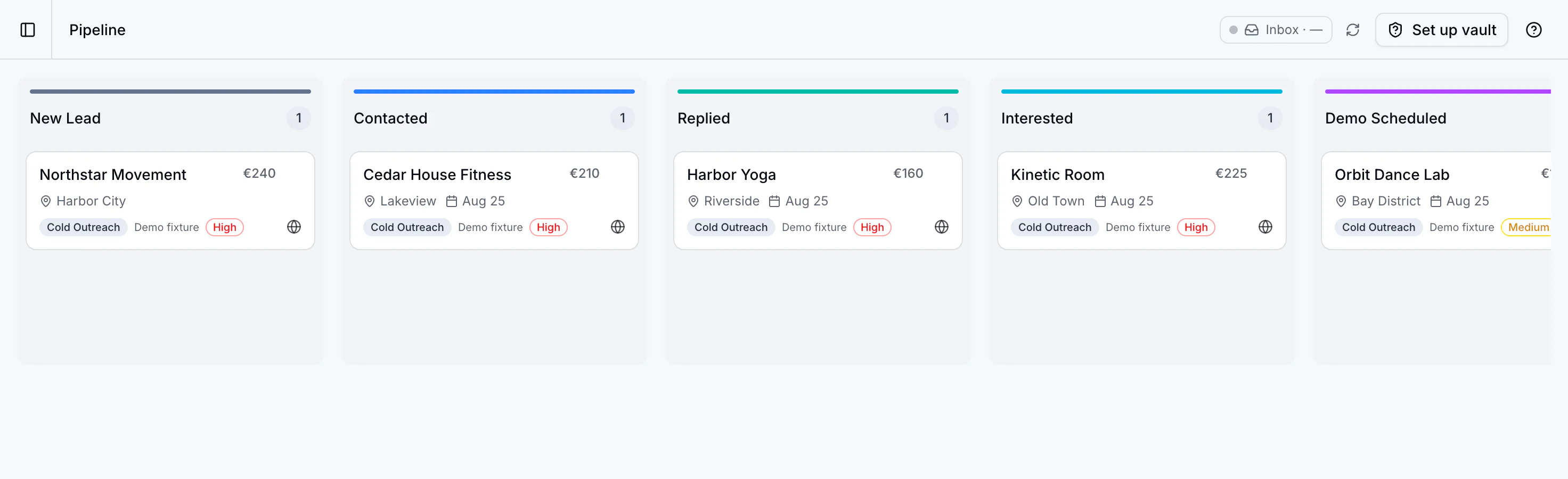
From a polygon on a map to a signed customer.
Six stages, one codebase. Nothing is stitched together by hand when the day ends.
Discovery
We draw a polygon on a map. Google Places fills it with real businesses, tile by tile, and the category filter drops the ones we can't help anyway.
Enrichment
A headless browser reads each website. A model pulls out who runs the place, what it charges and when it's open — and must hand back the line it read that from. The fit score is a formula, not a model.
The video
For that one business, a short video is recorded and published to its own link. The picture in the inbox is a screenshot of where the click lands.
The email
It goes out paced to that business's working hours, not ours. No tracking pixel.
The call
Two dialers, depending on the number. The call is recorded and transcribed on a machine in the room, not in somebody else's cloud.
The pipeline
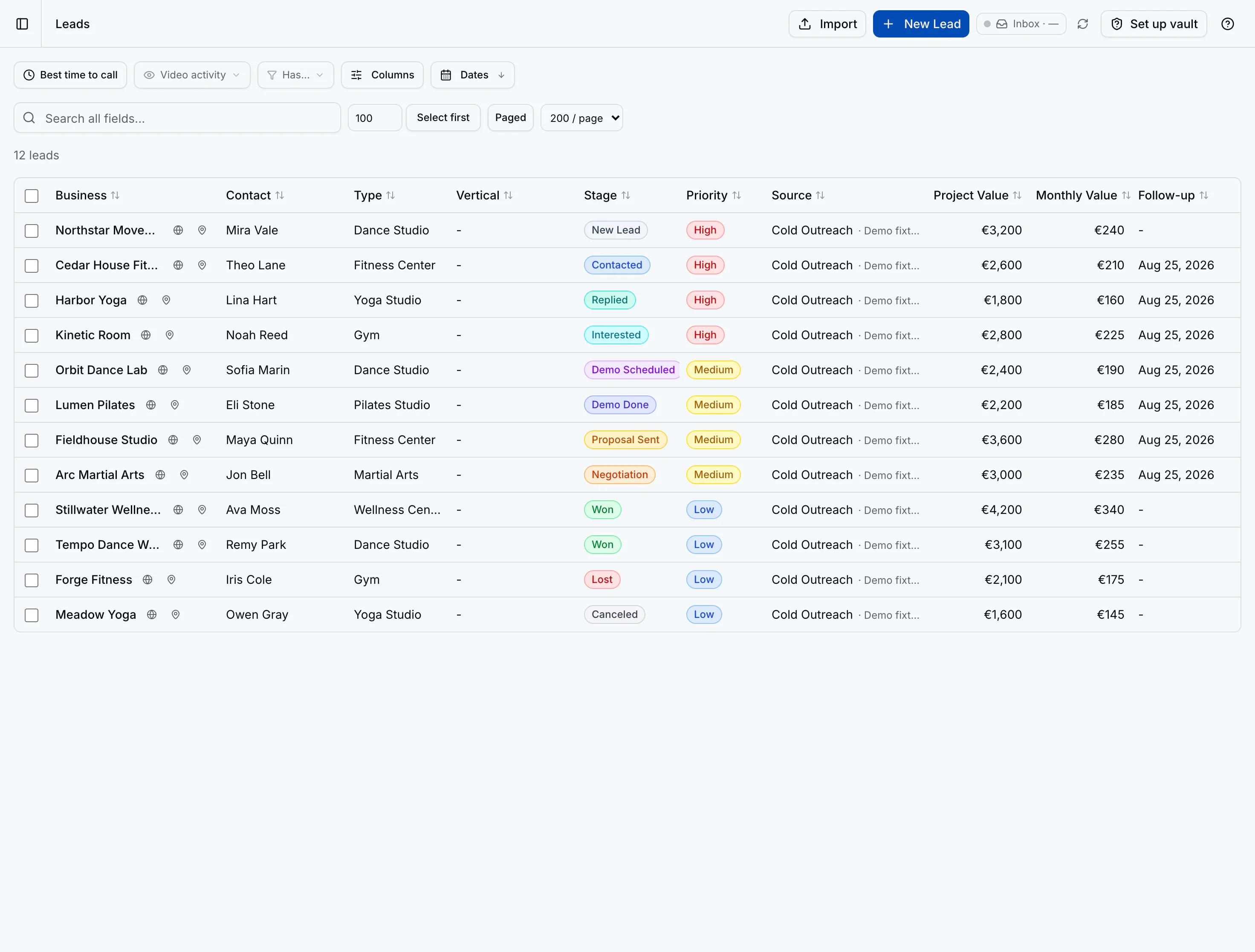
Twelve stages on a board. The recording, the transcript, the outcome and the report all land on that one lead's timeline.
Three reports, each about one business.
Every report builds a real page for that business, then writes the email that carries it. Nothing is a template with the name swapped in, and there is no PDF anywhere — it opens on a phone like any other page.
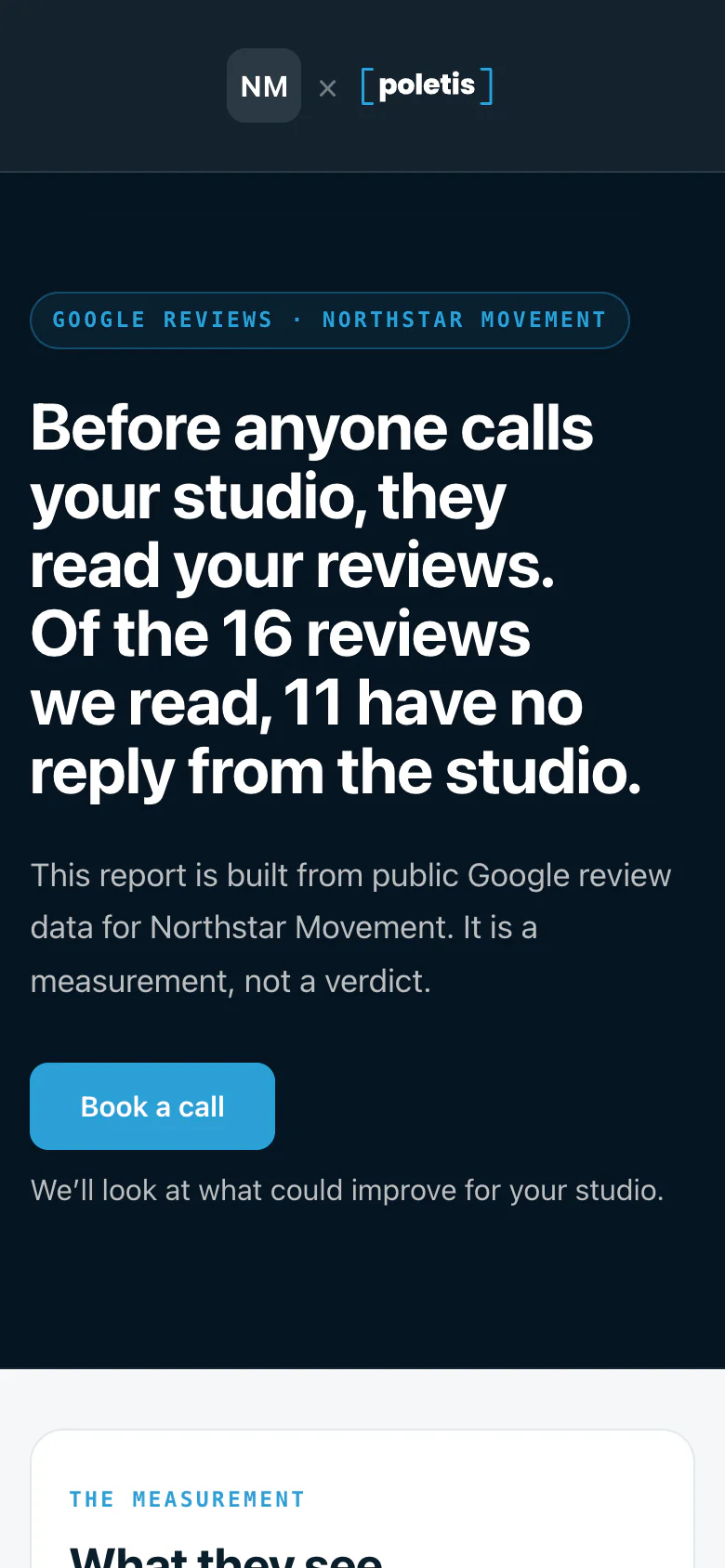
Report 1
Google reviews
What people actually wrote, read back to the owner: the themes that keep coming back, the quiet complaints, the months it went sideways.
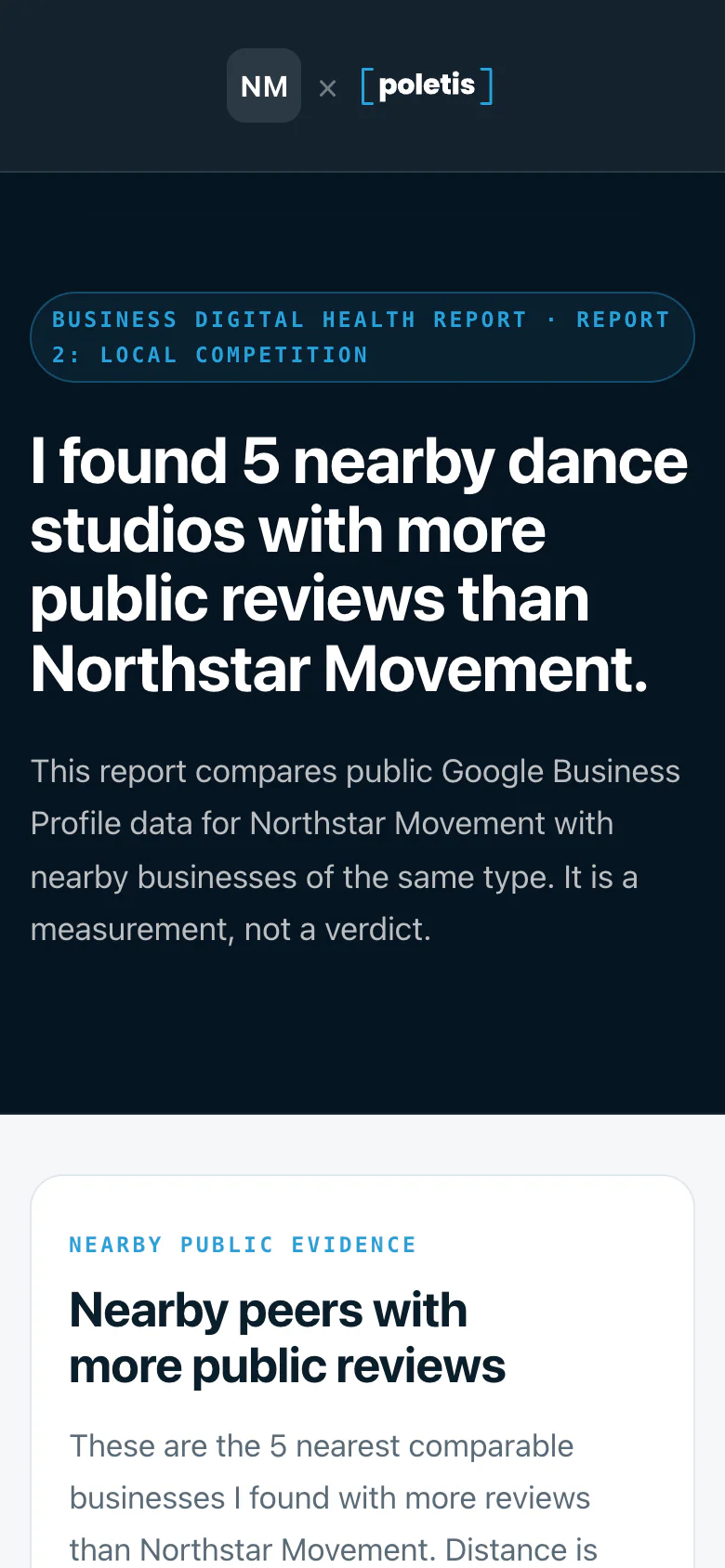
Report 2
Local competition
No model touches this one. It queries the businesses nearby and stays quiet until there is enough data to speak from — then it names three to five real competitors, with the distance to each.
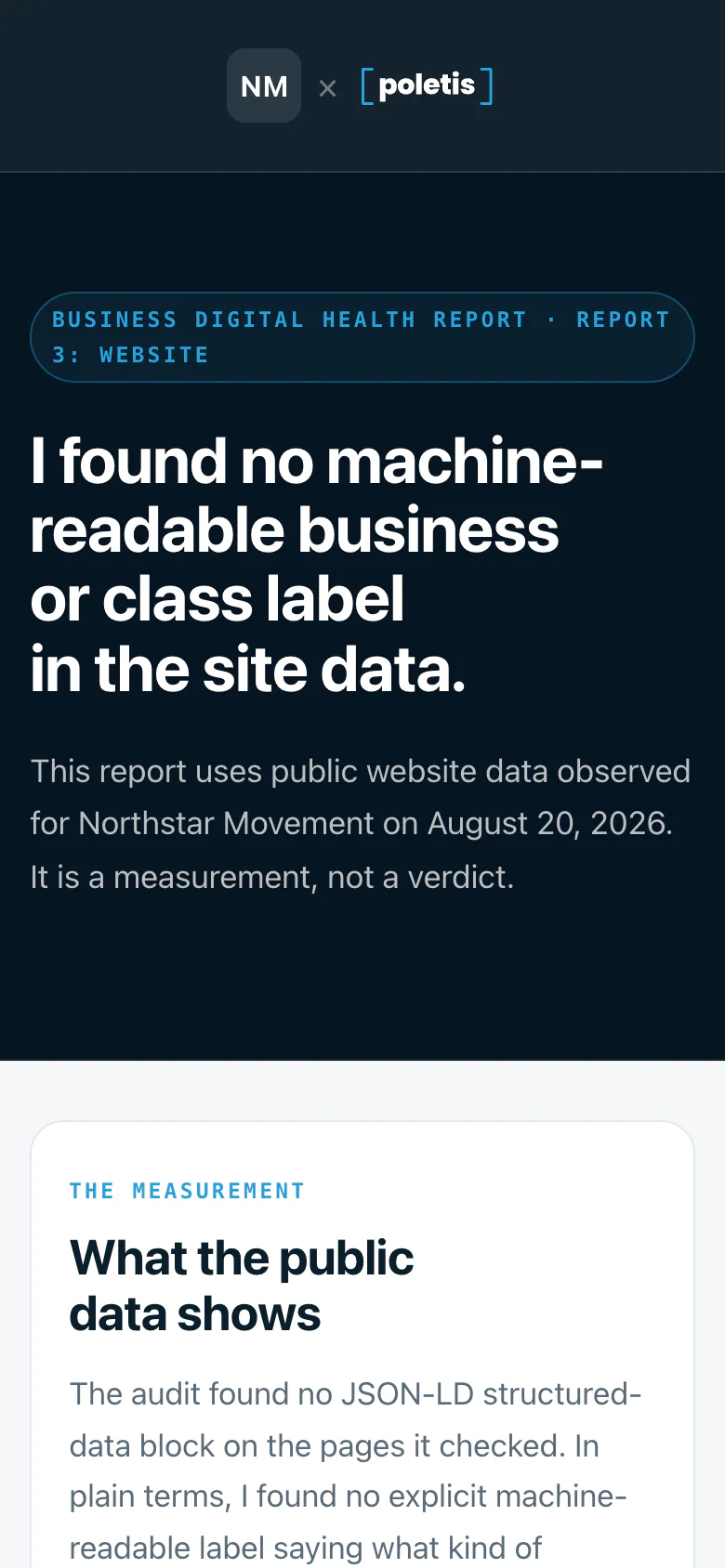
Report 3
Website and discoverability
What a customer meets when they look you up: how fast the page loads, what is missing from it, and what Google can and cannot see.
We would rather show you a neutral result than turn the data into a problem it never showed.
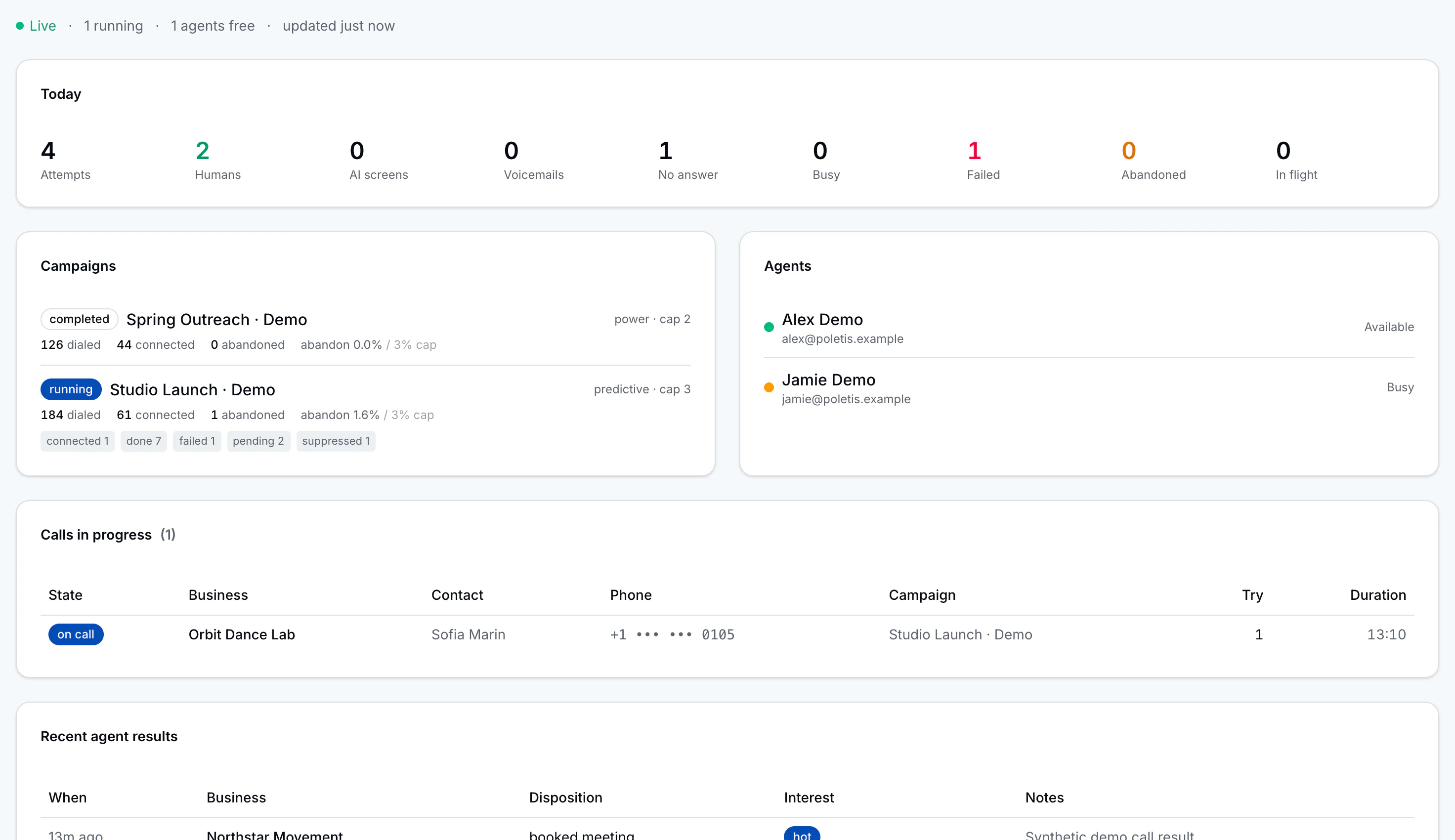
Two dialers, and a person on every call.
One is a predictive dialer on Telnyx — it decides who to call, when, and how many at once. The other drives a browser window, because that provider has no outbound API and we needed one anyway. Both hand the call to a human the second it connects.
- 01
Recorded and transcribed locally
The recording and the transcript are made on a machine in the room. The conversation is never sent somewhere else to be understood.
- 02
Voicemail is not kept
If the call hits an answering machine, the recording is discarded, not stored and read.
- 03
Do-not-call, enforced
One list, checked before the dial. Asking to be left alone is the end of it.
- 04
Cut-off callbacks
A predictive dialer sometimes drops a call it started. Everyone it dropped goes on a list and gets called back by hand.
There is no voice on our side that is not a person.
A walkthrough, once it is filmed.
A screen recording of the real system — the map, the enrichment, the dialer, the report.
The numbers we run on.
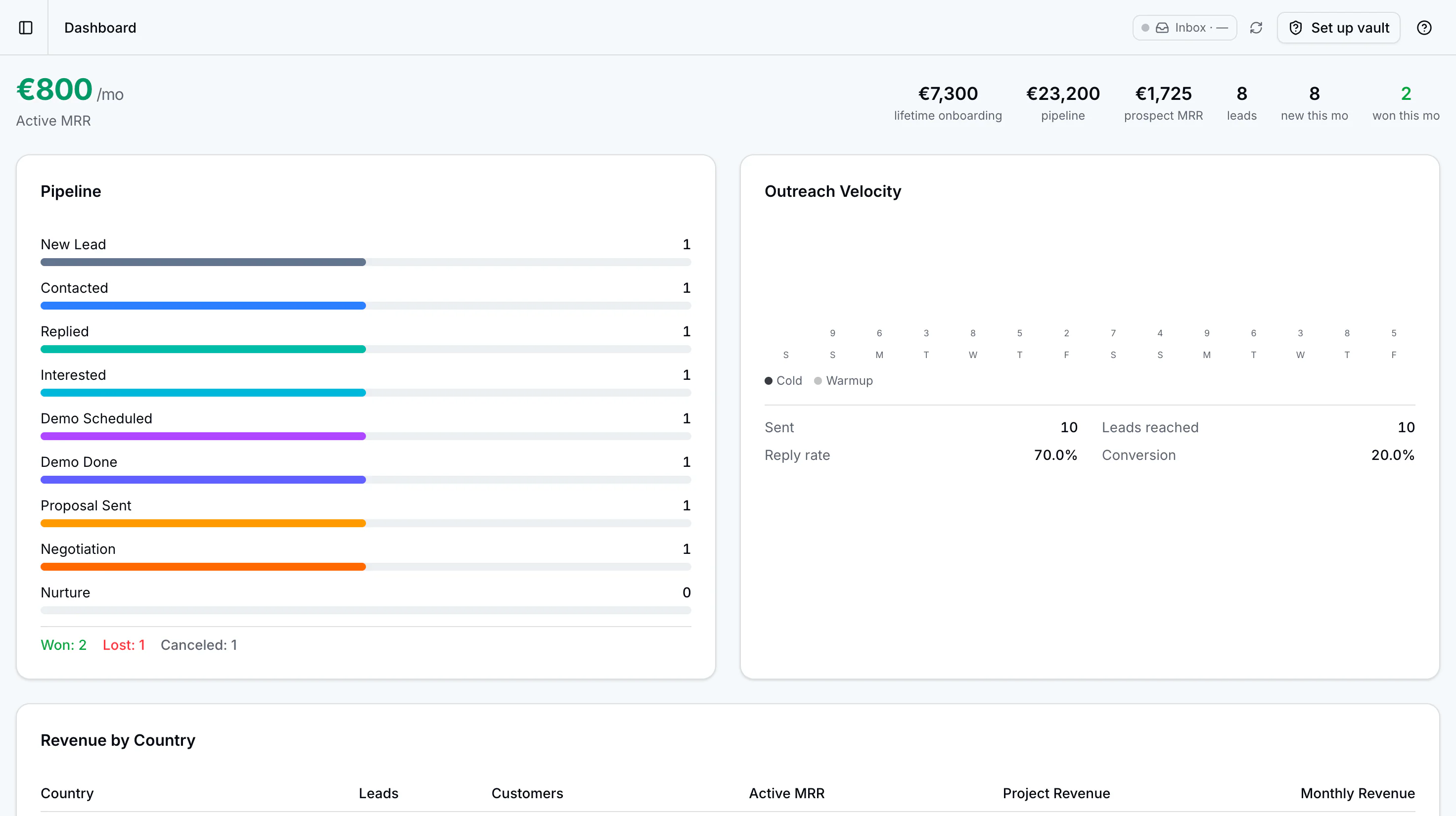
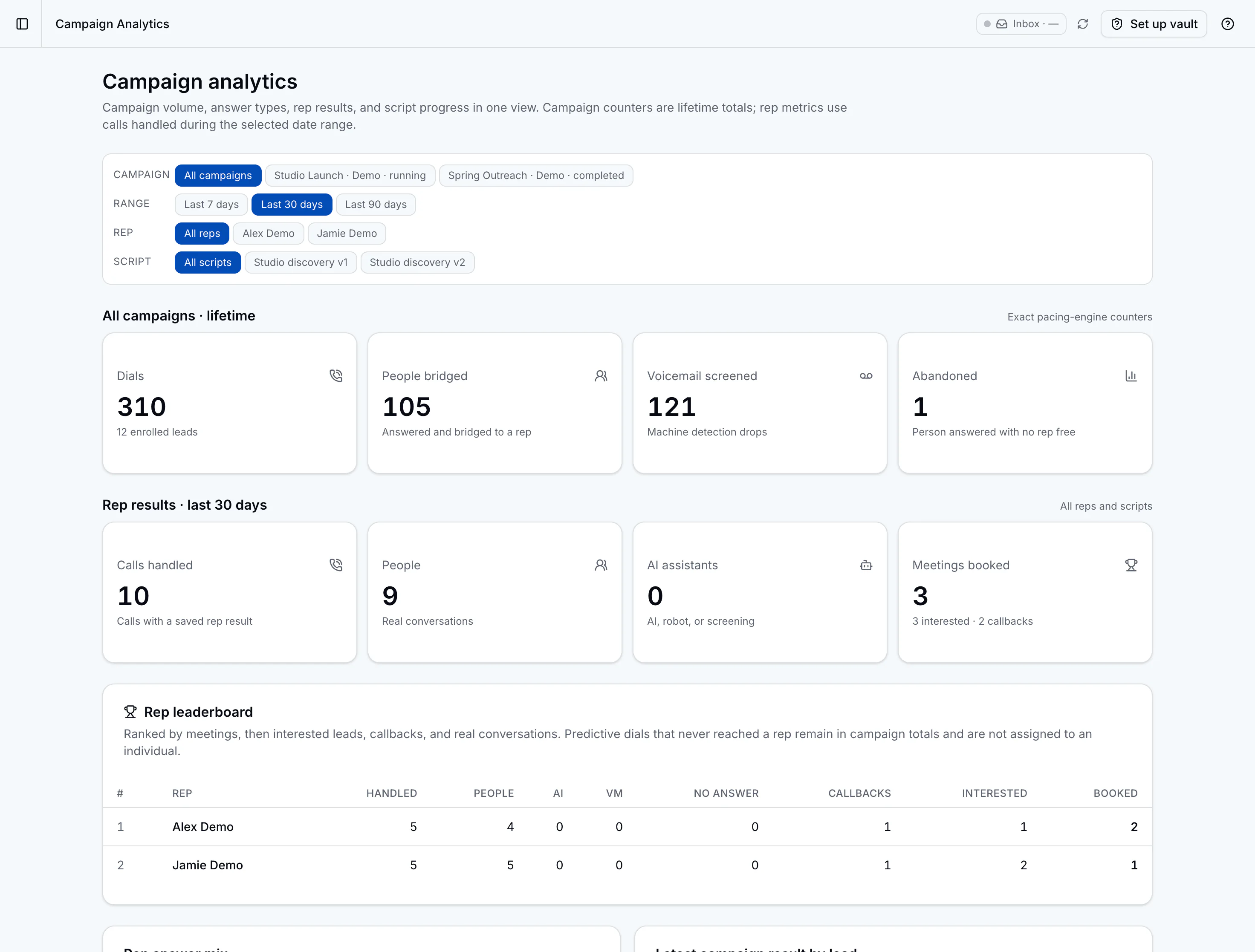
Nothing here is a vanity chart. Each one exists because a decision needed it.
- 01
Revenue and pipeline
What is actually being paid each month, next to what is still only a hope.
- 02
Funnel by stage
Where leads are sitting, and where they stop.
- 03
Outreach velocity
How much went out, and how long a lead takes to move one stage.
- 04
Template leaderboard
Which opening line earns a reply, and which one only feels good to write.
- 05
The dialer, live
Who is being called right now, and what happened on the last one.
- 06
Campaigns and exports
Every campaign broken down, and a CSV for when the answer is somewhere else.
Built the way the products are built.
Same repo shape, same review, same tests. Anything less would not survive a single week of real use.
It has broken, and we wrote down how. A parser bug once mis-flagged 1,226 audits out of 5,123; the fix came with a check that stops when it is unsure, seventeen tests, and a written postmortem that is still in the repo.
- data models
- 70+data models
- screens
- 50+screens
- test files
- 150+test files
- wired integrations
- 13wired integrations
- Google Places
- Gmail
- YouTube
- PageSpeed
- Resend
- Telnyx
- Quo
- Apify
- Outscraper
- Telegram
- WhatsApp Cloud API
- Vercel Blob
- Neon Postgres
You cannot buy this. That is deliberate.
There is one company in this system and it is ours. No customer logins, no second company inside it, no billing. The things that would turn it into a product are exactly the things it does not have, and we are not going to bolt them on just to have something else to sell.
It is on this page for one reason: it is the clearest proof we can give you of how we build the things you can buy.
What you can buy
Want to see it move?
Book thirty minutes. We will talk about what would actually run your business — and I will show you any part of this you want to see.
Thirty minutes, with the person who wrote it. No card, no signup.